By Borislav Petrović
All the Charms of Labin
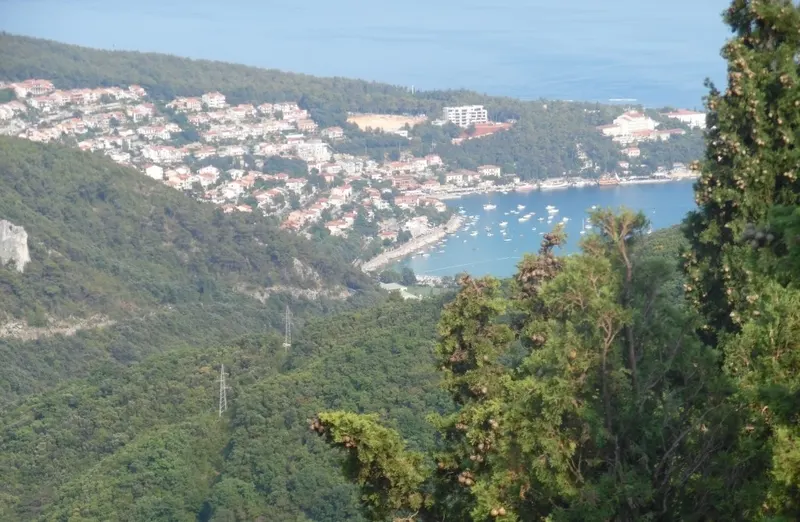
As Istria is full of surprises, the Art Press Caravan, at the invitation of the director of the national museum in Labin, got the chance to take a break from the Pula film festival and visit this old Venetian town that lies at 320 m above sea level. In a fairy-tale way, from this town – lookout one secretly observes Rabac and its coves. Beaches 5 km long, viewed from above, reveal a different reflection on the winding blue of the eastern coast of Istria. The view reaches as far as Cres and Lošinj. A 45-minute drive from Pula, on a hill above Rabac, lies medieval Labin. At first sight tourists fall in love with this Renaissance town – fortress. It captivates with the beauty of antiquity that makes it mystical. The sea is not far from Labin, so tourists can at the same time feel the beauty and peace on the heights, see the cultural landmarks, and yet on the other hand, only a ten-minute drive separates them from the sea and bathing in Rabac or the nearby Ravni. Labin has a steep and indented coast. The sea is much clearer at the foot of the town – fortress. The beaches are more beautiful than the western coast, which is quite low and shallow. The essence is that in a single day a tourist can combine culture and history with bathing and enjoyment in the beautiful Rabac coves. A place that seemingly stopped in time, it relaxes and offers enjoyment in a varied gastronomic offering.
Before the entrance to Labin there is the settlement – town of Raša. The youngest town in Istria, and still a mining one. It was built in 1936 according to the design of the architect Pulitzer. Conceived to be a town to human measure, for all that a mining family needs. It was once a modern town with a school, hospital, cinema, sports hall and a church dedicated to St. Barbara, the patron saint of miners. We found traces of mining history in the said church, in which a mining collection is housed. With the extinguishing of mining activity, the youngest town in Istria, which aged prematurely and in a short time wrote a lovely history, is today somewhat forgotten. Labin, an unusual fusion of mining and art, is a mining place that gave space to artists. In the present and recent past, this picturesque town records a flourishing of painting and sculptural art. Mining is seen and somehow felt in the traces and fragments of Labin and its surroundings, but slowly and surely it passes into the pages of history.
During the Labin Republic, art occupied the people of Labin in a tremendous surge. It is precisely on it that the present and future of the Labin art republic, as it is popularly called, is built. The Labin Republic is the new epicentre of culture and art in this part of Istria and Europe. It is a town that integrates fine art into life. Rich in art colonies and numerous studios and galleries, unusual, beautiful and specific in that it has a very large number of artworks and sculptures in the open, it is a place for all those eager for an encounter with astonishing cultural wealth.
The Art Press Caravan visited one such special place teeming with sculptural works under the open sky. It is the unique sculpture park known by the name Mediterranean Sculpture Symposium Dubrova. It is located 1 km from Labin. The idea was to make a unique sculpture park dedicated to the Mediterranean, where the only medium is stone. Everything comes out of stone and everything proceeds from stone. An open-air museum, Dubrova in fact explains and summarises the Mediterranean through stone, through that of which the Mediterranean itself is made. As there is stone in abundance in this part of Istria, it is no wonder that in the large sculpture park there are over 50 artworks of stone.
Over the past 50 years, selected artists left Labin one sculptural work each year. The White Path developed over the last 15 years. From the sculptures arose the project of the WHITE PATH. The old stretch of the path turned into one great artwork. That path has 15 sections. Each is dedicated to an artist who, with their skill, built themselves into the WHITE PATH for all time. Thus Džamonja, Murtić, Knifer and other “wizards” left their mark and stamp on Dubrova. It is incredibly interesting when, in the middle of nature, you suddenly come upon sculptures. The people of Labin managed to build art into the nature and surroundings of their place. At the same time they also revived the neglected nature with artworks.
The members of the caravan experienced walking along the WHITE PATH. An invaluable experience that you feel underfoot, and then along the whole body. Each section has its own vibration that each author imprinted in their own way. Each part of the path tells its own image in stone with a whole message that you either glimpse or clearly see. We carried that feeling to the old town core of Labin, which, with its charm and atmosphere that has “that something,” explained to us why the artistic paradise is precisely here. The core of Labin represents a fusion of the mining tradition of this region with the art that drew a large number of painters to this novelistic town. Over the last 150 years Labin was tied to mining. With the extinguishing of mining activity and production, Labin slowly began to turn into the cultural-artistic centre of Istria. Many projects and ideas sprang up thanks to the mining-workers’ heritage.
On those foundations, in the sixties of the last century, the “Labin Studios” appeared, an informal group of artists who in their own way “occupied” Labin with some 30 studios and galleries. In parallel with the artists from the old core, made up of classical academic painters, in the nineties yet another informal artistic troupe appeared, “Labin Art Express,” which in Podlabin took over the old premises of the mine. Labin came artistically to life when these mining premises were turned into a large artistic complex. A special experience was to see how the former mine became one large art gallery in which, over the last 20 years, exhibitions, concerts and performances are organised and spontaneously happen. Lately, serious scientific conferences are also organised in this mining gallery. In this way are joined the old town core, where the studios developed, the lower mining part of Labin that symbolises the alternative part of art, and the aforementioned Dubrova as the third segment of the artistic activity of this wondrous place.
The members of the Art Press Caravan were astonished by the visit and by what they experienced in the National Museum of Labin. The museum sublimated all that this small but incredibly interesting town is. Namely, in the museum’s cellar there really are mines, and at its top, on the last floor, we could see the Renaissance and Rococo. What “transitions” and a mixed wealth of impressions for us “caravaners.” As we went floor by floor, we realised that the whole history of Labin is thematically arranged across the floors of the museum. It is fantastic to feel and see, alive, how a complete cross-section of history, ethnography, archaeology, heritage and culture is stored in the museum, in one place. Just before the entrance to the miniature mine of the National Museum we received miners’ helmets and descended into a five-minute, 200 m long mining adventure. We immersed ourselves in the roles of the old Labin miners, coming out enriched by yet another tinge of living experience. We discovered that within the museum mine there is a Roman lapidarium. The museum is in fact Labin in miniature. That is why it is worth visiting.
When we came out of the museum, on the façade of an 11th-century church, our eye was caught by a statue of a Venetian lion with a ball in its mouth. We did not notice it by chance. We learned that it is a symbol of the acknowledgement of Venetian rule in Labin. The adornment of the town is the local sheriff, who dresses accordingly. Like the former “court jesters,” he entertains people and tells of his experiences from America, in which he has never been. He has a symbolic name. He is called Euro, the man called “money.” The walking money greeted us as we left Labin. With his appearance and his name, this unusual man of broad soul, in his own way, wished us a happy journey through life. Labin and Istria were most creatively described by our acclaimed dramatic artist and member of the Art Press Caravan, Branka Pujić, with the following words: “The charms of this medieval town and what most draws the curious are the obvious and interesting contradictions which, with the passage of time, and who knows, by some miracle perhaps of space, gained one colourful, meaningful whole. In the National Museum the opposites are most pronounced, from the Venetian carved furniture, where one sees that the upper class lived there, to the descent into the mine, where we experienced something quite different, and the artistic white paths which are divine. That fusion between the different is like a film about a miner who paints, makes sculptures and treads new white paths. The greatest wealth of Istria is its people. They are warm, open and enter into communication directly, almost in a second. They gave us a feeling of closeness and warmth. We learned their life stories. And they themselves had a spontaneous need to share them with us.” The recommendation for all people who had the patience to read the travelogue is: come, see for yourself and discover what the magic is of this once-Venetian town sprung up on a height beneath which the sea foams.