By Borislav Petrović
Along the Paths of the Art Press Caravan to the Golden Fleece
Along the Paths of the Art Press Caravan to the Golden Fleece
The Art Press Caravan, carried by a quiet inner call reaching from eastern Serbia, continued its missionary journey. Guided by the strength of a sixth sense, we found ourselves in Kučevo, a town located in northeastern Serbia, in the Zvižd region. Kučevo is 130 km from the capital. A subjective feeling tells us that this lovely region is so near, yet so left to oblivion and to itself.
Once this was not the case. Proof of this is the villa of King Aleksandar Karađorđević, which he built for himself in the immediate vicinity of the gold-bearing river Pek. Even after short stays in these parts, the king would be as if renewed, which made him feel more often a wave of freshness after which he returned full of energy to affairs of state. That this is not by chance is also supported by the fact that gold has been extracted in the surroundings of Kučevo since time immemorial. From the Romans who inhabited this region, to the Celts. God endowed these parts with gold, which gives them a wondrous tinge of mysticism.
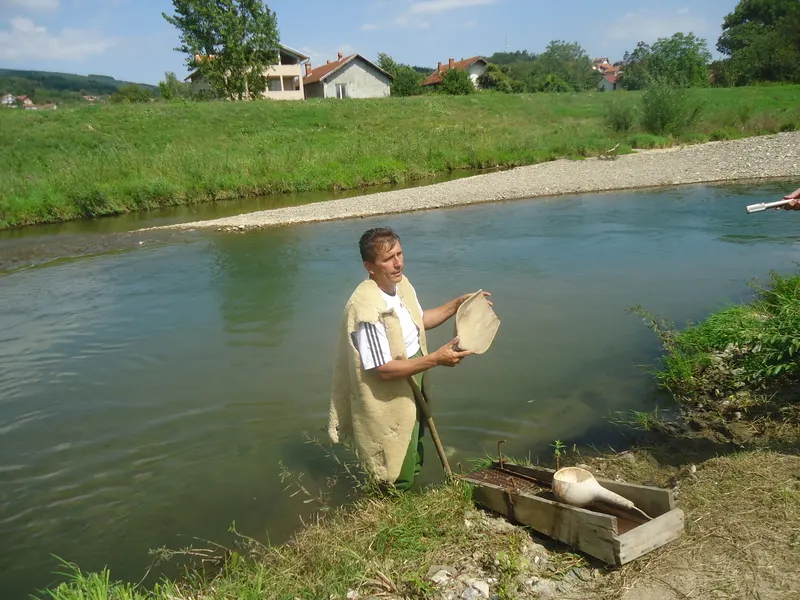
Gold panning on the river Pek is an indescribable experience. From experienced gold panners we also received instructions worth their weight in gold. When you go down to the river, you should be as relaxed as possible, in order to get a feel for which part to look for gold in. If the panner finds a few gold particles on the pan, it means they are on the right track, and guided by intuition they should continue panning. If the panner finds two or three particles in the water, that is a sign for them to continue panning in that spot. Within the Golden Fleece association, gold panning is done in the traditional way. The Golden Fleece got its name because of a story that actually took place on the river Pek. Gold was extracted from the river using a flayed sheep’s fleece. So the sheep’s fleece on the river Pek would take on a golden shine. It is impossible to resist the impression that in the act of gold panning there waft traces of alchemy and an imperceptible metamorphosis of colours and grains of sand. You watch, yet with the naked eye you do not notice that the white garment has taken on a layer of the colour of gold. The grains of sand turn into grains of gold. The gold-bearing sand of the wondrous river has the same shine as in ancient times. It patiently awaits new seekers infected with the wave of gold fever, keeping for them a part of the golden cargo. Zvižd is an old mining region in which both Roman emperors and Serbian kings sought gold.
The Zvižd region is also endowed with centuries-old beech forests, in whose bosom flow unusual rivers and streams that in their roar carry golden dust. Clear mountain streams from part of the Homolje mountains flow through gorges that in their own way shine. It is interesting that the streams also flow through caves, which gives them a creative trait with which the nature of Zvižd especially rewarded them. The crew of the Art Press Caravan, from the foot of Kučevo, caught sight of a great cross atop a hill. Drawn by the beautiful sight, our legs hypnotically carried us to meet it. When we drew near, we had much to see. Above Kučevo an imposing cross had simply sprung up, the landmark of the town. To the pride of all the faithful and the admiration of all passing travellers who find themselves on the hill bearing the name “Jelena’s Rock.” 18 metres high and weighing three tons, this metal cross watches over the town and shines at night, creating a magnificent sight. According to legend, the hill got its name from the shepherdess Jelena who tended sheep on that rock, and at one moment lost a ring she could not find. That this story is not just a legend is shown by an event that took place during the work on building the metal cross. Namely, one of the workers found the long-lost ring of the shepherdess Jelena, and with that seemingly chance find revived the legend and moved it into reality. A sign that something sublime had happened is that the cross was raised not long after, and the space around it was rearranged into the most beautiful town picnic ground. As if the shepherdess, after the finding of the long-lost ring, like an angelic fairy, blessed the rebirth of this place. From a once-empty hill, suddenly everything teemed with life, to which the lookout point also bears witness, now drawing a multitude of tourists and curious people in search of undiscovered beauties and new knowledge. From the lookout, the town of Kučevo is in the palm of your hand. You have the experience of touching the whole Zvižd basin.
Slowly we descended into the centre of Kučevo, where the kind hosts lavishly received us in the hotel “Rudnik.” In and around the hotel reigned a true carnival atmosphere strewn with folk customs. We attended a review of original folk creativity, the traditional “Homolje Motifs.” Held for the forty-seventh time, it ranks among the oldest cultural-tourist events in our country. Every year in the last days of August, Kučevo resembles carnival cities. Everything is in the sign of original folk dance and song. The folk customs of Zvižd and Homolje are presented, the tradition of this region is preserved through song and costume. Guest “carnival-folk” troupes perform in folk attire, defending the colours of their towns and the places from which they come. “Homolje Motifs” has been held since 1968, and it is interesting that every year the number of visitors grows who wish to be part of this creative review, which increasingly takes on the contours of a carnival in folk garb.
People from abroad and from the former Yugoslavia are drawn by the Vlach magic of the dance ritual that induces a kind of trance. It is performed by the “Rusaljke.” These are specially gifted women from Homolje who, like shamans from Lake Baikal, perform a dance and, uttering mantras known only to them, enter some other dimension from which they foretell events to come. Upon the end of the ritual, they return to the space-time reality, from which they do not remember the prophetic words they sang in the state of trance. People who watched and listened to the “Rusaljke” testify to their prophetic chants. Ethnologists claim that they fall into a state of rapture by means of a ritual that belongs to an ancient religion. The Rusaljke are the heirs of fairies and sorceresses, who are their extended arm from ancient times. They revived the myth in our present, preserving the cults of distant ancestors. It is believed that they draw inspiration from the strong cult of the goddess Cybele, who was considered the great mother of the gods. The phenomenon of the “Rusaljke,” saved from oblivion, is a real charm for mystics and a challenge for the scholars of our time.
The crew of our Caravan, under the impression of the Homolje Motifs, set off to the Ravništarka cave, located 12 km from Kučevo. Ravništarka irresistibly beckons with its vestibule and the beauty of the main cave channel. We stepped onto the unusual channel, over 500 metres long. In the manner of a natural guide, it gradually led us into the cave’s charms. The interior of the cave exudes a wealth of cave jewellery. A true treasure is the visual experience offered by the waterfalls, but not those to which our eyes are accustomed. From afar they seem frozen to you, but when you are in their immediate vicinity, the clarity of the petrified waterfalls is read out. Going deeper into the cave we came upon a “swan lake,” which, because of the beautifully shaped stalactites, resembles swans.
We continued to explore the cave, and at one moment a whiteness and shine startled us. On our faces was visible the excitement at the sight that suddenly appeared to us. A white castle radiating whiteness. Shaped as if sculpted by hand. The creative director of this (super)natural masterpiece is the Ravništarka cave. Intoxicated by what we saw, we came upon Marko Kraljević’s dappled horse, ornately fitted and regularly winding stalactites that recall a folk motif from an epic poem.
The hosts from the tourist organisation prepared a surprise for the ages for us. From the distance, the sounds of a violin could be heard. We thought we were imagining it. We did not believe our sense of hearing because of the time spent in the cave. However, when they led us into an ornate cave hall, everything became clearer to us, and our wonder at what we saw grew. We were glad that we had not imagined the music reaching us from somewhere. We caught sight of a talented violinist from Kučevo who, from an improvised stone stage, gave us a unique experience – a mini concert inside a cave. Never-before-experienced, we dare not also say unrepeatable. One never knows with caves. In an extraordinary and lively manner, the hosts from Kučevo saw us off from the world of the wondrous Ravništarka.
Upon leaving the cave, having passed through Kučevo, the Art Press Caravan ritually bade farewell to Zvižd, returning to Belgrade. In terms of time we arrived in 90 minutes, but in thought and experience we returned from Kučevo for much longer. We were well and truly in Belgrade, yet the return still lasted for days. A long journey that refreshed us. The saga of Kučevo took a trophy place in the showcase of memories of the Art Press Caravan.