By Sanja Domazet
Balaton — between water and fire
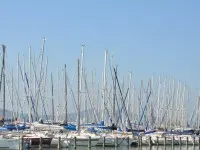
At the end of August, galvanised by the light, with a moon cold and distant as ivory, I went to Balaton — without wishes, without hope, with the days behind me heavy as open graves, deep as Roman wells in which the living dream, the frightened spirits of some former gods. I was fleeing from the memory of a July in Dubai, hot, dark, painful, immense, and I longed for water, for azure, because water quenches every fire calmly and the shadows in it flicker only briefly and the waves carry them off somewhere soundlessly, mutely, into eternity, with garlands of August grasses that are dry and crisp and singing, transparent and light as shadows.
Balaton is the largest lake in central Europe, but to me it seemed like a violet and green cradle, edged with white, shimmering feathery lace — those were the hot bodies of swans that, soundlessly and with quiet triumph, hovered rather than swam upon the water. I swam between their warm, folded wings, those little boats of tenderness. At night I listened to the river Zala, Roman, secretive, full of bright-eyed stones, the lake’s only inflow. In the morning we came here again to swim, cheerful, in colourful bathing suits, and the lake lay on its back and, through endlessly long mornings, it was more malachite and golden and let the sun dip into it its belly of foam and wistful gleam. I belonged to no one, “only to the golden point of that lamp.” On the Gyenesdiás beach the leaves stole kisses from the lake they call the Hungarian Sea, and I thought of other kisses, heavy, wine-dark, distant, with a taste of “quicklime” and violets. And I thought how good it is that everything ends, because thus the pain that does not cease reminds us that we are alive, that “our heritage was left to us by no testament,” and how we must endure it when they leave us, because sooner or later we will have to see the beloved square of a back and how it slowly grows smaller, down the road, while the prophecy of distance falls upon it like a shroud. At Balaton — and the meaning of the word is Muddy Lake — I watched the moonlight dewily illuminate the landscape, dancing and trembling in the dark, the clouds curdling, and from the glasses only fair-haired, white wines glinting, soft-lipped, that do not intoxicate, that do not dull the pain, only sharpen the memory. During the Roman Empire the name of this lake was Shallow Lake.
In the wine-dark of night, you hear the echo of the voices of Roman soldiers dancing above the water. On the Keszthely beach I felt like weeping; I watched the diving boards, children tumbling about in the sand and the grass of late summer like starfish, and listened, like little bells, to their laughter that slid across the symphony of light in C major cast by the weakened sun, made heavy by the sweet passion of grapes transparent and graceful and tart. My past and my present met, at times, in the dawn of sleepless nights.
The future, tormented in advance, I felt only at the Balaton feasts, where soft-handed townswomen served us, bringing before us platters of foods in Van Gogh’s colours — green as fire, sunflower yellow, red as the evening sun’s orb. From the Esterházy beach, where invisible doves, otherworldly white, pecked absently, I gazed at the Tihany peninsula, turning blue in the distance of the green wind, all in the colour of ice and of some painful memories. A child was selling marzipan sweets along the promenade; you could buy a whole town, white, rosy, rising like leaven, with a taste of Eden and of death and of quiet reconciliation. The light of this region is strange, dense and golden. The main promenade is called Tagore, because the famous poet Rabindranath Tagore came here to heal his heart. In the evenings he would usually wander the corso for a long time, and then sit until midnight over a single glass of wine, watching the waves of gentle, sickly moonlight and listening to the uneven beats of the ailing heart on whose account he had come here. The locals loved his saintly smile and how he stroked children’s restless, merry hair; those in love knew his verses by heart, but he did not listen to them, he would wave his hand gently, as if ashamed. One morning, in a dawn of bright dust falling upon the rooftops, I set off to wander far. My pain went after me. I walked a little along an uneven path, dusty and umber-coloured. And then it was as if the landscape opened and revealed the bare breasts of the earth themselves, budding upon ground brown and scorched as the crust of some host. Those were vineyards; honeyed light trickled all around, and enraptured little birds, tiny and trembling, twittered, intoxicated. White butterflies, the souls of the dead, hovered above the bright downpour of grape clusters. The whole moist-green shore of Balaton is fertile for viticulture, hence so many wines of every kind. On the northern side of the lake are the most famous wineries, Csopak-Füred and Tiffány, where the most famous wine is made, the franjevac. From it the lips swell as after kisses, and the franjevac summons certain dreams, mystical, quiet, otherworldly.
All around Lake Balaton, at night, the lights of bars, cafés and restaurants crowd together, white as lilies. Sometimes we sat there at night and were silent; it was a calm, joyful solitude in togetherness, and the nights became reliquaries for certain faces and dreams we remembered, that smiled at us, but whose names we did not speak aloud.
At times the calm, sleeping back of the lake would shudder, as if the lake were dreaming an ugly dream. But that was no dreaming; in the green moonlight we would see only the crystalline tail of a fish that had leapt up and silvered the night for an instant. Lake Balaton has forty species of fish. Sometimes, at night, while we swam, I would run into their shoals. They would make space for us in that watery darkness, where on the bottom the sea-grasses danced to the organ music of the water.
Every night they called us to Siófok, which lies on the southern side of Lake Balaton, and there people dance, drink, kiss and love infinitely lightly, because everything lasts only until dawn. But I did not go; I would fall into the white, gentle ditch of the bed and dream only of the dead, winged, stroking my face. And I was not afraid. Balatonfüred is a town on the northern shore of the lake; it smells of the sweetness of grapes and of transience, and the grapes that ripen then have soft mouths and the wistful taste of a host. There, when autumn reddens and when the first blood of fallen leaves sprinkles the earth, a great number of wine festivals are held. Some people, moustached, distant, with shining eyes, sell or drink wines, or both drink and sell them. And there is nothing painful in them. Everything is simple. Oh, why could I never be like that? On the most beautiful shore of Lake Balaton, Zamárdi, full of tiny black sparrows, like musical notes hung upon the trees, of restless larks and invisible ravens, I breathed in the night air of Balaton, I breathed honey and light, thinking how love is tart, intoxicating and bloodthirsty, and trying to pray to a certain Christ who hid in the branches, dark, winged and so beautiful. I felt a fever from his gaze and, trembling at his presence, I moved on. Somewhere in the distance, invisible bells rang voluptuously, shaken by the invisible hands of a summer that was dying on the cross of a starless night. Of all that bliss “I carried away only the fragrant shadow of the ellipses of uncatchable birds.”