A European Oasis of Culture in Pécs
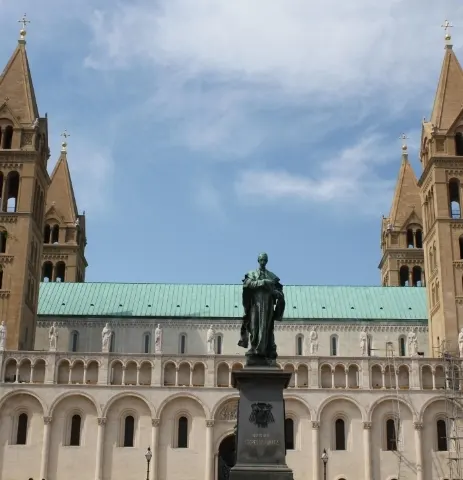
The Art Press Caravan set off for Hungary. Not by chance at all. Led by the strong call of culture, we found ourselves in Pécs. Setting out on our cultural campaigns, it won us over at first sight. A blend of tradition and the modern — you cannot help but admire it. Beauty in its buildings, and you feel the vibrations of the Mediterranean. You walk its streets, expecting, from behind some house or corner, a glimpse of the blue expanse of the sea.
The breath of the Pannonian Sea hovers over the city. Although it long ago passed into history, it is as though it left in the air a trace of blueness you can smell. Bequeathed to Pécs through some inexplicable channels of time. Because of the Mediterranean spirit that flows strongly through Pécs, the Hungarians call it the Hungarian Mediterranean.
The buildings are colourful and symbolically reflect its multicultural setting. Besides culture and art, gastronomy is another of the values in which tradition is nurtured.
Motifs of South Slavic, Swabian and Hungarian cuisine dominate. The Art Press Caravan team experienced this distinctive gastronomic experience at the restaurant THE HOUSE OF CHAMPAGNE. It is located in the premises of a 19th-century CHAMPAGNE factory. It has its own history that lends the setting an authentic note. Tradition is not betrayed even in its appearance, since it resembles wine cellars. A creative gastronomic team enriches the spirit of this unusual restaurant, which in a way naturally evolved from a champagne factory into THE HOUSE OF CHAMPAGNE. We learned that wine does not tolerate noise. It enjoys silence. The wine is indulged by being stored deep in the bowels of the earth, on five underground floors beneath the restaurant. The official champagne of Pécs is called CATHEDRAL FIVE TOWERS, FÜNF KIRCHEN, from 1991. The champagne has five flavours that symbolise five different nations. The meaning lies in the name itself.
The Caravan continued along the first wine road in Hungary, which took us to Villány — the best and oldest winery. Red wine is its trademark.
The Villány wine cellars carry a certain magic. The liberated spirit of wine that shimmers through the cellar breathed new energy into us. We recognised it through a surge of excellent mood. Interestingly, from the scent of the wine we had the impression that we had already tasted it. That came a little later, when we got to know the secrets of its production. In this way we experienced the journey by which the grape is transformed into wine. One of the wine cellars drew us into a room that exudes mysticism. Wooden chairs with narrow tall backs arranged in a large circle. In the centre of the circle a sun, and immediately around it the twelve signs of the zodiac. As if the wheel of time had turned backwards and stopped in the era of King Arthur and the knights of the round table. Our imagination clearly came alive. We could picture the primal images of warrior winemakers who, by the act of initiation — the lowering of a sword onto the forehead and head — become knights. Villány and its surroundings offer a wide range of possibilities for visitors. The castle in Siklós carries its own secret and story. Siklós is a small town known for white wine and grapes. The special charm that sets this town apart from others is that it has something many cities do not. An Orthodox and a Catholic church and a mosque, on such a small area, give Siklós a particular seal of nobility imprinted with the spiritual treasure that makes this place irresistibly attractive.
The Zsolnay Cultural Quarter as a city within a city
The next morning was a real revelation for the Art Press Caravan team. The Zsolnay Cultural Quarter in the heart of Pécs. A city within a city.
It carries its own flow of time and rhythm of life. Surrounded by walls, it lives its own world. It is a twenty-minute easy walk from the city centre. The cultural industry and its magic attract 150,000 visitors over the course of a year. Interestingly, the number of visitors who come in a year equals the number of inhabitants of the whole of Pécs. When you go a little deeper into this cultural complex, it becomes clear at once why Pécs was crowned with the halo of European Capital of Culture in 2010.
It all began in the mid-19th century, when the first manufactory was founded — the porcelain factory of the Zsolnay family, which reached world fame after two decades. The tragedy of the Zsolnay family begins in 1948, when the state smashed all the porcelain moulds and turned the famous brand into a cable factory. The descendants of the famous family live abroad. The Zsolnay heritage management maintains contact with the surviving members of the family, which is a rarity these days, and at the same time shows deep respect for tradition and for the founders. Part of the secret of this cultural quarter’s flourishing lies in that relationship. The Zsolnay family brand is enduring. Preserving the brand’s roots is very demanding, while on the other hand one cannot rely only on the 19th and 20th centuries. The art of the 21st century itself must work in parallel with the old art. Together they form an artistic whole.
Festivals are held in the pyrogranite courtyard. The courtyard possesses a particular atmosphere that does not allow you to simply leave it. It has five exhibition spaces. The grounds of the cultural quarter stretch over six hectares. There is a puppet theatre. The Pannon Philharmonic holds forty classical-music concerts within the quarter itself. Eighty jazz concerts take place over the course of a year. The very structure is a special synergy that is distinctive relative to all of Europe.
The Press Caravan saw a demonstration manufactory of porcelain production. The Pécs brand also has a demonstration glove manufactory, whose production process we witnessed. A measure of the appeal and world fame lies in the knowledge that the famous singer Madonna orders gloves exclusively from Pécs. A traditional Pécs value is the Organs. New activity, a new detail, must constantly be devised to keep things interesting for the inhabitants of Pécs, and especially for tourists. In such a tendency lies the constancy of this cultural shrine’s success. To gather the segments of tradition in new garb and new attire. The diversity of content gives people the guarantee that everyone can find a suitable experience to match their own affinity.
From historical, cultural and spiritual values a foundation arose, upon which the Zsolnay heritage management rose. Here bridges have been built that join history, culture and art into one whole. They have no sea and not too many spa centres, but they have the wonders of Zsolnay tradition and porcelain. True values are not those we can merely touch with our hands, but those we experience — only those are truly ours. The secret lies in the love of art and the respect for tradition, reflected in the constant maintenance of the bond with the descendants of the Zsolnay family.
Walking through Pécs, beneath your feet you feel the living energy with which the city pulsates. It has been passed from previous generations to the present one.
Recorded in the collective consciousness, it gives birth to energetic, creative people. They enrich this space with new ideas, culture and history. They add to it in our time. They build it here and now. The Art Caravan has its own theory, according to which inspired people, in moments of inspiration, recognised creative solutions that had existed all along and hovered over the skies of Pécs. Quietly and patiently, and invisible to the naked eye, these god-given ideas waited in hiding for some genius to recognise them and set them into a whole. The spiritual eyes of the chosen ones were opened. Ideas from the collective consciousness were caught and carried into our dimension. They began to live out this visible picture of events of ours.
In support of the pulsating liveliness of the streets we felt beneath our feet stands the knowledge of the existence of tunnels beneath the centre of Pécs. A large number of underground rooms and corridors are living testimony to our intuitive experience. Reality, and part of the secret we glimpsed.
A magnificent statue of a horse adorns the centre of Pécs. By its beauty and size it ennobles the main square. Symbolism is never accidental, given that the horse is an expression of the gracefulness and nobility that this lovely place undoubtedly carries. Michelangelo’s Sforza horse came to life in Pécs. The great artist’s project, which the creatives of the Hungarian Mediterranean were the first to bring to fruition, in a style all their own. They made an incredible blend of heritage and the contemporary. They gave the tunnels beneath the city centre a purpose, by filling them with water. They serve as a foundation. Full of water, the tunnels have the weight to support a copper horse of 30 tonnes. In this way the horse invisibly floats on the surface, while being grounded by the water-filled tunnels. Heritage and value were given a contemporary application in a lucid way.
The view from the basilica, which is in the immediate vicinity of the horse, is on a gentle rise from which a breadth of vista that thrills opens up. You have the impression of looking at certain streets as on a map in which rivers have their tributaries. Everything somehow branches out and naturally connects. The setting of forested hills in the distance, above the city, completes this natural décor into one small whole. Like a picture on canvas.
Of Pécs and its medieval university, the part of history that tells of the Turkish campaign, as well as of why it is part of world heritage, there will be more in the next text.
Presenting a new travelogue as an episode in the series Art Press Caravan on its campaign to Pécs. We are simply reluctant to reveal all our impressions at once. There were many of them in a short period of time. Let them wait for their time of harvest. In the meantime we keep them as treasure in the special chambers of the Art Press Caravan. They are stored as valuables in our improvised safes. Living experiences and true values do not fade with time, but shine all the brighter. Just as gold does not lose its value and shine with the passing of time. The cultural, spiritual and historical treasures carried in mind, heart and soul, we carefully transfer to the secret vaults of the Caravan. Where they dwell in the eternal freshness of the first impression. The code of the freshness and eternity of cultural treasures is known to the chosen keepers of the Art Press Caravan.