By Dragan Jovićević
In the Frame of Natural Scenography
Dragan Jovićević | 31 May 2014 – 18:11h | Photo: RAS |
If you love the Turkish series broadcast on our domestic channels, or if you follow the rapid development of their cinema — which this year reached the highest recognition in the world of film, the Palme d’Or for Nuri Bilge Ceylan’s film “Winter Sleep” — then you have surely noticed the extraordinary coastal locations that often make up the film and television scenery.
These landscapes are mostly filmed in İzmir, a coastal city almost twice the size of Belgrade both in area and in population, which represents a true cultural and historical treasure, a capital of art and culture, right on the coast of Turkey.
That this is so was confirmed by a team of domestic journalists and artists, gathered around the unique project “Art Press Caravan”, whose aim is to convey to the public the little-known beauties of cultural diversity.
So the Caravan, this past week, with the support of the Office for Culture and Tourism of the Embassy of Turkey, found itself in İzmir, right between an earthquake of more than six on the Richter scale that shook that city and the triumph of Ceylan’s film on the Cannes Croisette.
In İzmir, the Caravan met with the local city director of the office for culture and tourism, Abdülaziz Ediz, who spoke with delight both of the cultural significance of this city and of its further progress. Namely, given that, as we have already noted, İzmir is often the screen for the impressive backdrop of frames of Turkish films and series, a large film studio is currently under construction, where filming will take place in the future, which will further improve production.
“We used to import series from America and the West, and now we increasingly export our own,” said Ediz, adding that they themselves had been surprised by the great popularity of the series. Most of the series that can be seen even on domestic channels are filmed in İzmir, but not so much in the city itself as along the coast, precisely because of the overcrowding of the city itself. “If you see seaside shots in some Turkish film or series, you will not be wrong in saying they were filmed in İzmir,” Ediz says, adding that at least 75 per cent of films and series were filmed there. The large film centre is already under construction and next year the first clapperboards should “drop” there.
The Art Press Caravan meeting with the director of the office for culture and tourism of İzmir
As in all great capitals, so in İzmir the artistic season lasts from September to May, while during the summer season, from June to September, festivals and artistic projects alternate.
İzmir still nurtures the culture of going to the cinema, whose attendance there has fallen only slightly, while a particularly interesting fact is that the city itself has three large theatres within national institutions and as many as 35 private theatre houses, which perform both classical and modern repertoire, as well as the repertoire of Turkish dramas.
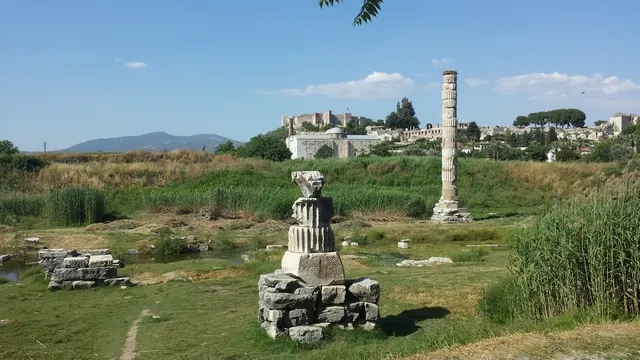
Modern art is especially complemented by the sites of ancient cities, such as Ephesus, the Agora, the house in which the Virgin Mary died and the grave in which the apostle John is buried — out of which churches were made — as well as the Temple of Artemis, to which the pagans bowed, and the İsa Bey Mosque, one of the largest in the region.
The team of the Art Press Caravan from Belgrade — consisting of Slavica Hinić, founder of the Caravan, Nebojša Pilipović as creative director, and journalists Marija Miljević Rajšić, Sonja Todorović, Nataša Đuričić, Stanislav Stankić and Dragan Jovićević — toured all the mentioned sites, as well as the famous Pamukkale, or “Cotton Castle” as the Serbian translation of this wonder of nature would read — of which the Turks are especially proud — formed by basins created by the flow of hot, thermal water.
From our hosts we learned that, precisely because of the hot waters that spring up in several places, the İzmir area is especially prone to earthquakes, so that the one of the previous week was not a particular surprise, even though it caused panic in the public.